AI is now essential for businesses across industries. It accelerates delivery, optimizes processes, and deepens understanding of customer behaviour. Calculating the cost of AI development in 2026 is more critical and complex than ever.
Global spending on AI solutions is projected to surpass $1.8 billion by 2030.
This article breaks down the key cost factors, outlines realistic budget ranges, and answers the central question for decision-makers: What does it truly cost to build an AI product today?
Let’s explore the details!
What Operates AI Development Cost?
Several categories combine to produce the full AI development cost for a product. These products recur during the lifetime of the product and influence each other.
- Design & Research: POA, feasibility studies, user research, and prototype experiments. Early discoveries require expert time and reduce downstream work.
- Labelling and Data Acquisition: It includes sensor deployment, raw data purchase, annotation, cleaning, and quality assurance. Top-notch labelled data is often the single largest variable in cost to make an AI product.
- Model development: Choosing or selecting models from fine-tuning to training a custom architecture, validation, and hyperparameter tuning.
- Compute Infrastructure: Cloud GPU/TPU time, networking, and storage for inference and training. Infrastructure becomes the dominant recurring expense for many of the projects.
- Compliance and Security: Secure data pipelines, privacy engineering, audits, and documentation for regulators are included.
- MlOPs and Monitoring: Model registry, CI/CD, drift detection, automated restraining pipelines, and observability.
- Personnel and Overhead: Salaries for data scientists, DevOps, ML engineers, product managers, and designers.
- Iteration and Maintenance: Data refresh, model updates, bug fixes, and feature additions.
Each of the above components constitutes the total AI development cost. It may vary for different use cases.
Budget Buckets (Practical Examples)

We have given some realistic ranges for the cost to make an AI product in 2026. These are expressed as total project budgets from prototype to first production release, assuming a 6-12 month delivery cycle to develop AI tools with production-ready deployment.
Small pilot: $50k to $150k
These are single-model, limited-dataset, and cloud-only constrained scopes where teams use minimal MLOps. Here, the AI development cost is dominated by developer time and modest data-labelling expenses.
Medium Product: $150k to $700k
These are integrated products with custom data pipelines, stronger MLOps, higher SLA requirements, and moderate labelling needs. Infrastructure for medium-sized models and more robust monitoring boosts average AI pricing at the project level.
Professional Grade Solution: $700k to $5M+
Complicated workflows like multi-models, regulated domains, and real-time inference at scale require specialised cloud infrastructures. These require rigorous compliance work and larger multidisciplinary teams. This bucket shows the AI development cost and is distinctive when availability, latency, and audibility are critical.
This is the summary of the cost to make an AI product. It can fall outside these bands depending on the edge cases.
Analysing the Numbers: Where the Money Goes
Let’s consider a simplified cost split for a modern product budget, like $300k total. It will help decision-makers translate these ranges into their expectations:
- Data acquisition and labelling cost 25% for sourcing and QA.
- Model development and experimentations cost 20% for prototyping and fine-tuning.
- Engineering and integration cost 25% for APIs, backend, and front-end features. Good front-end UX reduces cancellation and increases conversions, especially on stores selling complex products. See our guide on the best WooCommerce variation swatches plugins to improve product selection experiences and drive checkout performance.
- Infrastructure costs 10% for cloud GPU/TPU costs and storage.
- Monitoring and MLOps cost 8% for automation, observability, and pipelines.
- Security and testing cost 7% for legal checks, pen-tests, and audits.
- Project management and overhead cost 5%.
Essential Cost Drivers for Reduction in Expenses
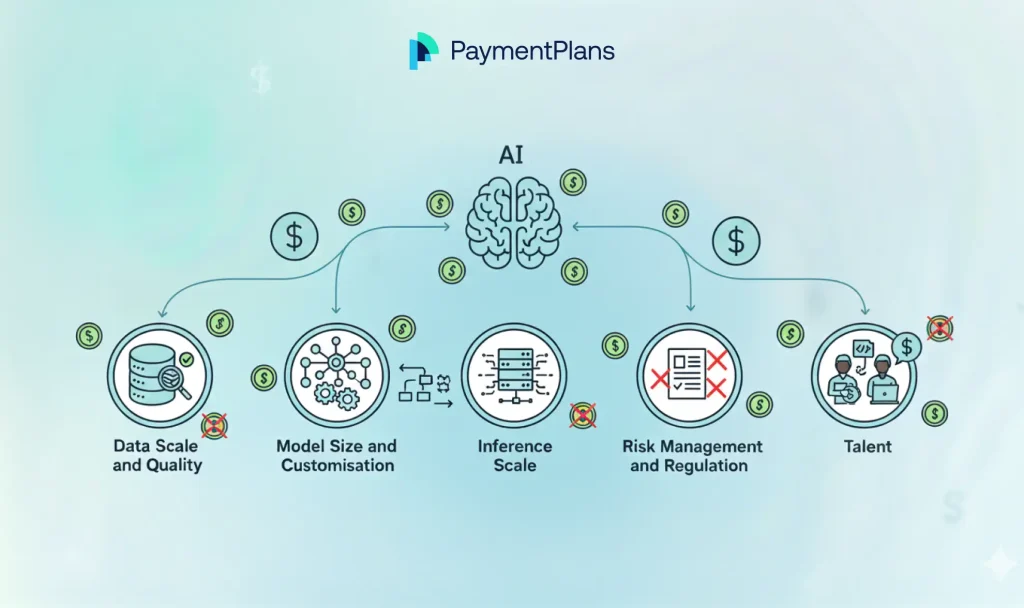
You need to understand the variables that affect AI development cost so that you can optimise budgets.
Primary Cost Drivers
Data scale and quality:
Cleaner and labelled data is good for success, but it increases the upfront costs.
Model size and Customisation:
If you are training from scratch, it will cost more. If you fine-tune large pretrained models, it will reduce compute and development time.
Inference Scale:
Low-latency services and high-throughput multiply infrastructure costs.
Risk Management and Regulation:
Finance, healthcare, or defence require compliance-heavy processes.
Talent:
Experienced and skilled ML engineers and domain experts command excellent compensation.
Common Cost Reduction Levers
These are the common cost reduction levers to help you cut costs:
- Reuse pretrained models and reduce computation by transfer learning.
- Shorten development cycles by prioritising minimal viable feature sets.
- Utilise active learning for a reduction in labelling volume.
- Go for serverless inference or managed services to minimise ops overhead.
- Outsource non-core tasks to specialised providers while keeping sensitive data on-premise.
You can materially lower the cost to make an AI product by applying these levers and also preserve the product’s viability.
Estimating Return

When you are budgeting AI development costs, you should pair the ROI framework with it. Evaluate the benefits, time savings, increased revenue, and cost avoidance before comparing them to upfront and recurring expenses.
Use cases with high-value and clear operational metrics are easier to justify at higher average AI pricing.
What you can do for a disciplined approach is:
- Define quantifiable KPİs before building.
- Use speedy experiments to validate impact hypotheses.
- Evaluate the total cost of ownership over a 2-3 year horizon with retraining and model drift handling.
- Compare the total cost of ownership against estimated advantages to compute the payback period.
Timeline Expectations and Hidden Return Costs
Time to launch also affects budgets. İf you accelerate short-term spending with overtime and larger infrastructure speed, it increases the AI development cost.
Post-launch, data pipelines, monitoring, and feature iteration can amount to 15-40% of the initial project cost, but it depends on the product.
Practical Checklist to Check Before Estimation
Before you make a final budget estimation, make sure you have:
- A clear and measurable set of success metrics
- Estimate of labelling effort and inventory of available data
- Risk assessment for privacy and safety
- Staffing plan and vendor listing
- İnfrastructure plan
Wrap Up
AI development cost in 2026 remains a function of choices that include data strategy, model approach, infrastructure, compliance needs, and time-to-launch. Typical project budgets range from $50k to enterprise-level, exceeding $5M.
When you decompose cost into components, focus on high-impact experiments, and carefully scope the minimal viable product, you can manage average AI pricing. You can improve the odds that their investment generates measurable ROI.